Showing posts with label olden days. Show all posts

22 June 2010

The Pipecleaner Man

This is a fictionalized piece of something I'm still in the early stages of working. I posted it on a forum a few months ago, and have only made a few small changes since. There is a bigger story here of which this is only a tiny part.

To offer you the same background I offered them (since so much of the story is missing) - - -


1. When we moved from Lincoln Air Base to Beale Air Force Base, the Capehart Housing for Beale's senior NCOs was only about 75% full. I think that much of the housing had been built in anticipation of the 9th SRW (strategic reconnaissance wing). Many of these houses lay vacant for over 6 months before we moved in. On top of that, the oak trees (blue oaks) already growing there were inadvertently killed off by the contractors...who put in topsoil much too deep for the trees' roots to do their jobs.

That first year we lived there, most of the lawns were brown from neglect, and half of the deciduous trees (most all of them oaks) were dead or dying.

2. My father hated the man who moved in across the street. I still don’t know why. It might have been something as basic as territory…Sgt “Krestus” wasn’t in my dad’s unit…

3. Sgt. Krestus' wife died from cancer. And the day after she died, Sgt. Krestus shot and killed several birds roosting in his yard. It’s always been mystery to me why those birds didn’t fly away with the first shot…but then it was mystery that they started gathering in his yard in the first place.

4. The day after the APs arrested him for discharging a firearm in a residential area, my brothers and I went into his back yard…we found more than a dozen dead birds…we collected them to bury them in our yard…the other thing we found…was a sucker growing near the base of one of the dead oaks…new life from a dead tree. We talked about this guy for years…we named that summer for him: The Summer the Pipecleaner Man Killed all those Birds.


“Sgt K is dead.” It was October – a school night. And we were sitting down to a supper of meatloaf and mashed potatoes. Dad stood at the head of the table, smug, pleased with himself, as though he’d done the deed himself.

“Sgt K? The Pipecleaner Man?”

“Yep. Day before yesterday.”

“Poor Sgt K.”

“What’d he die from?”

“God killed him.”


”For chrissakes, Brennan, don’t tell them that. They’ll believe you!”

“Good. Because it’s true. Eye for an eye, Krestus killed those birds, and God killed him.”

“More likely, he died of a broken heart.”

“He probably killed those trees, too.”

“Jesus, Brennan. He was only there for three months. Those trees were already dead.”

“He probably cast a spell on all of them from wherever the hell he came from. He cast a spell on those birds. He was a witch. God casts out witches.”

I slipped from the table, and looked out the front window at the Krestus’ old house across the street. The dead trees were gone now, blue oaks, cut down the week after Sgt K was arrested. And for two weeks after that, a van and 5-Ton stayed parked in the driveway while men in green coveralls and heavy boots chopped up the felled trees, put down new grass, and added siding and new paint to the house.

There were saplings there now. Sweet Gums with trunks no bigger around than a man’s thumb, two in the back yard to replace the oaks, and one in the front, marking the halfway point between the street and the porch.

Someday its leaves would block the view from this window, but today I could still see Sgt K sitting there alone, soaking wet, back against the door, his knees drawn up against his chest. He was wearing a dark blue robe, but it was open. And in cotton white boxers on cotton-white skin, he looked naked, but for the two black socks drooping in a pile below his bony ankles. He was crying.

That was August. Three months after he and Mrs. K had moved in…


+ + + + + + + + + + + + + + +
As children, it was not uncommon for us to park ourselves on the sidewalk just barely out the Movers’ path. We were waiting for children. New neighbors always meant new children.

It was the middle of June, 106° in the shade. School was out for the summer, and we were all in our bathing suits just in case we should run into a sprinkler.

Sgt. Krestus was the only man we’d ever seen who was taller than Dad. He was skeletal, bony. And he was bone-white. His body was covered in a fuzzy sort of skin that stretched so thin you could see the corners of his bones, hints of pearl shimmering in patches under his knuckles, his elbows, and sometimes his Adam’s apple. Mom called him ‘wiry,’ and more than once we looked above the places he stood to see if he was actually held up a wire. When he moved he hummed, and when he stood still it was always at attention, a single strand of white horsetail on a slender bow, still vibrating from its last draw.

We waited as he helped his wife out of their Lincoln. She was as thin and as pale as he, but more grey than white. She was wearing a blue muumuu with large white blossoms and blue terry bedslippers. And a green silk scarf molded so perfectly the shape of her scalp that I knew she couldn’t possibly have hair growing there.

I must have started at this thought, because Sgt K looked straight at me. His eyes were a deep teal, set so close they might have been one eye, except for his nose, razor sharp and almost blue, a beak jutting two proud inches from his white face. Somewhere in its shadow was a mouth, but there were no lips to help me find it. I wondered if he had no proper mouth at all, and if it was a beak that tore the food from his dinner plate.

He walked Mrs. K to the porch, and in an instant, lifted her right out of her slippers, floating her up the steps, over the small porch, and through the front door. Dwayne was right behind them retrieving the slippers. He followed them up the steps, and dropped them next to the door just as it slammed. In that same instant, on a sunny day with not a cloud on the horizon, a clap of thunder shook his house and the ground beneath us.

Dwayne leaped from porch, landing almost in front of us, running. And as he passed us, we all turned to follow, and didn’t stop until we’d put both yards, the street, and our own front and back doors between us and man with pipecleaner skin.


15 March 2010

I was a Nurse.

I became a CNA in the late 70s. I attended a single-semester (15 weeks/8hours per day) program in northern California, my first four weeks in a classroom and lab, where our instructors (RNs) showed us how to check vitals, wash hands, and give proper backrubs. For good measure they threw in a wee bit of anatomy. They taught us how to make beds.

The final 10 weeks were spent in clinical. Depending on your standing in the class, your acute : long-term experience ratio could be portioned anywhere from 2:8 weeks to 8:2 weeks. I was scheduled to a long-term care facility for two weeks, and to one of the local hospitals for eight.

To say I loved my work at the hospital is an understatement - I felt as though I'd found a new and better religion. At the end of my third day on the medical ward at Fremont Hospital, I was offered a job. And the day after I received my certification I started getting paid for doing something I would have done for the rest of my life for free.

For a few years I worked as a nurse's aide, both in northern California and in northern Montana. But the economy went south, and Tom got laid off. A man who could not not work, Tom went back into the Corps.

We moved to Camp Pendleton/Oceanside, where btw, there were no immediate openings for CNAs. Even for one with a few years post-surgical experience and a bevy of references. So I took a job as a cook, and I stayed a cook for the entirety of Tom's re-enlistment. And while at Pendleton, I attended a local community college, and started working on my general education requirements. (expository writing, chemistry, biology...)

As soon as his new obligation was fulfilled, we came back to Montana. But with no shortage of LPN and RN students, the hospitals in my area were not interested in a CNA who hadn't worked acute-care for over four years. So I settled for long-term. I hated it, but I stuck with it till we could afford the tuition for the LPN program.

It was a vocational program lasting four quarters (48 of 52 weeks). The first two were didactic, and the balance was made up of clinical rotations through the different wards of both hospitals, and in OB, Psych, ER, OR, and even a week in a doctor's office.

I started the program with 22 classmates, but only 5 of us made it to clinical. The first two quarters were like finals week the entire stretch. I felt as though I'd crammed the first 6 months of school. My brain was full. And as I hit that wall, I wondered - Was this a stupid idea? Am I going to have wasted all this money and time, only to find out I hate nursing?

[But] my very first day, my very first hour, on 4-south (a post-surgical ward) at Saint Patrick's Hospital, it was as though the Holy Spirit, Himself, had washed through my body. I'd come home.
- - - -

I took the long way to my RN. After graduating from the Vo-Tech, I re-enlisted in the Army. And even afterwards, when I got back home, I still worked for another year or so as an LPN.

And then, even as I attended university, I didn't focus on a Nursing degree. The Course Catalogue was a candy store. There wasn't a subject I wasn't interesting in learning. Overall, in addition to my non-transferable Vo-Tech credits, (and my post-graduate credits), I racked up some 170 undergrad-credits, only 64 of which were part of my nursing component. If I had been independently wealthy, I would have stayed in school till I exhausted the entire catalogue.

Okay. So this entry is to respond to something an LVN (whom blogger.com had to bar from stalking this blog) wrote: that I never discuss my experiences as an RN. I'm not sure what she's looking for. Something exciting? Something extra? I can't help but notice from her posts that she names names of patients she's had that were celebrities. Hm. Did I assist in any surgeries on any well-know personalities/politicians or their families? Yes. Will I drop names? No, and hell no.

Did I participate in exciting, complicated procedures/surgery? Sure. Did my RN make a difference? Absolutely. Did all that extra schooling help? Yes. Did any of it become old hat? No. Every evening before any scheduled procedures, I would review the patients' charts, I would review their pathologies, and I would review the procedure itself (including imaging myself going through the motions). Every single time.

But it's redundant to post about it. I am a nurse. These things are what being a nurse is all about.

So, what does she want to hear? Something extraordinary? How about the time several of us brought party balloons into an empty OR on April Fools Day, and breathed in the gas before calling the front desk to report a Helium leak?

Or maybe time I sank to my knees sobbing, because an old man I recognized from choir died before we could stop his spleen from spilling the 8 units of whole blood the 2 circulating nurses were squeezing into him?

Or the time I climbed into bed with a 3-day, post-MVA alcoholic, screaming in terror at snakes in his water pitcher, so that I could prevent him from further gouging his lips and eyes?

I'm sorry to disappoint, but while nursing is an extraordinary profession, it is not a profession for those who seek the extraordinary. Our work is honest, simple, no matter the scope/extent of our education. We solve problems. We figure out best how to keep a patient oxygenated, nourished, eased from pain, rested, healing...safe.

Not 6 months before I was diagnosed with this stupid IQ-stealing tumor, a student RN rotating through the OR wanted to observe the open reduction and repair of a Le Fort II fracture. I let her scrub in and stand beside me. (As first assistant I stood opposite the surgeon, and our scrub tech stood beside him.) The student was so excited, I thought she was gonna wet herself. She was fascinated by the itty bitty-ness of the implants. A woman after my own heart, I appreciated what she was going through.

She had hundreds of questions about Advanced Practice nursing, but only one do I remember clearly. She asked me, "What do you like best about Nursing?"

I told her, "Making beds."

14 September 2009

September Harvest


It was 105 degrees in the shade, and there was very little of that where the Sierra foothills lazied into grassy dells and sleepy hummocks near the flightline at Beale.

A mile from the old POW barracks, we found 6 young trees standing in the wild oats - two perfect rows of three, three perfect rows of two. Small, narrow leaves fluttered between silver and green on willowing branches lifting in the hot breeze. Dad warned us not to eat the fruit.

We piled out of the stationwagon, dragging 2 bed sheets apiece, and we spread them beneath the slender reaches, tucking them up against the trunks. Dwayne and I climbed up, and rocked them in the wind. And for ten minutes they dropped a hail of green pebbles, a soft drum of fingers on the cotton below.

07 April 2009

Beached

I was 14 months pregnant, and weighing in at one hundred and eighty two pounds. I was standing in front of the swamp cooler, sweating, when the little man in the radio announced that it was 117° in the shade. Hell with this, I'm gonna stand under some cold water.

It was 1970, and with my first husband, I lived in a wee house. It was a small cottage, one of several in a row, built sometime in the late 4os. The bathroom was so tiny (3 by 5? feet) you couldn't open the door without hitting the toilet. And you had to sqeeeeeze past the sink to get into the shower. (I would shimmy in sideways, letting the bottom of my tummy drag across the rim of the sink.)

The fixtures were all new: the toilet, the sink, and the shower. The stall was 3 feet square, with shiny, stainless faucet knobs and a sprayer. And it was completely tiled in 3-inch squares of white ceramic, all the way to the ceiling. It was closed off with a turquoise, vinyl drape patterned with a checkerboard of yellow fishies and odd green plants that looked more like saguaro cactus than sea foliage. The floor was also new. A green linoleum that clashed enough with the shower curtain to make me sick to my stomach. I tried not to look at it as I side-stepped into the shower.

God, it felt sooo good - cold bliss running its fingers through my hair, cupping my breasts, and running its smooth palms over my round belly. I stood there for 15 minutes when it occurred to me, why stand when I can sit? So I let my back slide down the wall behind me, till my bottom felt the cool tile below. I pondered my feet for awhile, trying to remember what it was like to have toe knuckles and ankle bones....and the days when I still had an abdomen, and could reach under to wipe myself after tinkling, without dislocating my shoulder.

Ten more minutes of daydreaming, and I realized it was starting to feel a little chilly. Mission Accomplished. Time to get up, and get dressed.

Only I couldn't seem to get up. I tried to shimmy back up the wall. Not a chance. I tried to slide out of the shower sideways, but I couldn't lift my enormous ass up over the 3-inch lip at the bottom of the stall. I tried rolling over the lip, but couldn't maneuver my thighs over my tummy. Finally, I settled for turning off the damn water. Great. I can't reach the knob.

So I sat.

And I rehearsed what I'd say to my husband when he came home expecting dinner, only to find the cook beached in shower stall.

I reminded myself, it could be worse. My bladder could be full.

oh, hell.

24 February 2009

Conspiracies

When choosing between a conspiracy of lies or one of silence, it's better you should choose silence.

Two months before Dad went to Nam, Dwayne ran a table leg through my bedroom door.

He was chasing me down the hall, and I managed to get my door closed before he could make contact. The leg drove right through the wood like a spear.

The story was that Dwayne was simply walking down the hall carrying a table leg, and tripped over something on the floor right in front of my bedroom door, which caused him to twist around just I happen to be closing my door.

Well, we all got the belt for lying, and just two days before we moved to Sacramento, Dad repaired my bedroom door. The inspectors from Base Housing never knew.

We lived in Sacramento for a year waiting for Dad to come home from Nam.

And he wasn't back 2 weeks when my youngest brother, Hugh, kicked in the bottom panel of our bathroom door.

Patrick had done something to piss Hugh off, and when he ducked into the bathroom to escape harm, it pissed off Hugh even more.

After we got over how cosmically spooky it was that we should be dealing with another door, we went into action. We knew that no story whatsoever would convince Dad this was an accident. So, taking a page out of Dad's book, we decided to keep our mouths shut, and repair the door.

Mom and Dad were spending the day house-hunting back up near where we lived before, and they weren't due back for another 8 or 9 hours.

We didn't have any wood, and quite frankly, no one had exactly stood around to watch Dad repairing the first door, though he did tell us more than once the particulars of his brilliance in hiding Dwayne's crime from the inspectors. Something about making diamond-shaped biscuits, one for each side of the door...fitting them in, and sanding it all even...then re-painting. We had no idea how to duplicate his process, so we decided that tape might do the same trick...give us something to paint over.

There was plenty of matching paint. The entire interior, including all the doors, had been painted just before we moved in, and there were still 2 gallons in the garage. And there was never a shortage of masking tape in our house. Mom used it for everything. Mom was always refinishing or painting something.

So we carefully removed the splinters and sanded the panel and wiped it clean. Then, strip by strip, we taped from one end of the panel to the other, overlapping the tape by the just an eighth of an inch. It was a group effort. Hugh pulled the tape, and Patrick measured 24 inch sections, and then Hugh cut the tape, and handed it to me.

The panel was 20 inches tall, and the masking tape was a little more than an inch wide. It took me over an hour just to apply it. There were many fuck ups that could not just be undone...I couldn't remove just one strip of tape. Each time a mistake was made, I had to remove everything, and start over again. And every noise outside convinced me that Mom and Dad were about to burst in and catch us.

Dwayne had a delicate hand so he painted a fine coat over the taped panel, and we took turns holding the hose from Mom's hairdryer to blow heat on it. And still Dwayne waited an extra hour before he would risk painting another coat...and with that coat, he also painted the entire door.

While I'd been taping, Dwayne vacuumed the living room and the hallway. While Dwayne painted I cleaned and rewaxed the kitchen floor. Hugh and Patrick spent most of the time arguing while they cleaned their bedroom, putting away all toys, and re-making their beds.

The house reeked of paint. So we got the idea to repaint the other 3 doors in the hall, and what the hell, why not the one to the garage? We had the perfect cover. After all, we'd be moving soon...weren't we gonna hafta paint those doors, anyway? Such helpful children no two parents should be so lucky to have.

5 hours after we finished painting and cleaning, Mom and Dad came home.

As soon as they smelled paint Mom went looking in the kitchen cupboards for missing dishes, and Dad made a quick inspection of our rooms looking closely at all the windows. (oops. that reminds me of another story for another time.) They both checked for broken furniture and carpet stains.

Obviously they were suspicious. Obviously, we were obvious. I mean, everyone knows rule number one: if you know you're in trouble, clean your room, do the dishes, and paint the house.

We moved back to Beale 3 months later, and on that last day in the-house-we-lived-in-while-dad-was-in-nam, each of us kids must have looked at that panel a half a dozen times.

Dad never knew.

21 February 2009

Spilling Oxytocin

Years ago, even before LPN school, I spent a summer working the night shift in the Neonatal Nursery at Kalispell Regional Medical Center. It was one of those banner years, when everyone seemed to be in labor. We helped deliver dozens of unexpected babies. Moms on vacation from places like Texas, New York, California, British Columbia, (and even one from Germany) were delivering babies in Kalispell, Montana.

We were filled to capacity. Our nursery was designed for 13 well babies and 4 NICU babies. All of our beds were full. We were medevacing women to Libby, Missoula, and Spokane. And it wasn't just well babies that were coming in record numbers. Even with the 4 NICUs, we had to send sick babies to Salt Lake City and Seattle. (We had one born 21 weeks gestation, and another whose mom presented placentae abruptio.)

I mean we were busy, with a capital B. We even had contracted, Traveling Nurses from Quebec and New Zealand to help staff the NICUs.

Consider this a preface, a mural, a backdrop to what I'm dying to tell you. For like 14 weeks straight, there were babies everywhere; Nurses rushing from room to room; Women screaming; Docs, midwives, tribal elders all talking at once. Patients and family speaking Blackfeet, Crow, English, French, and German - medical jargon, pleas, profanity, yelps of joy...everyone in blue scrubs and blue paper shoes.

And in the nursery, wee babies. Bundles of love who had no clue what mayhem their arrivals wrought.

As with most hospitals, our policy regarding post-surgical, bottle-feeding moms (C-sections, tubal ligations) was to let them sleep that first night. When it gets down to it, back then, unless mom specifically asked that she be wakened to feed her baby, we pretty much let her sleep the night through, anyway.

It was the nursery staff who feed their babies. Me. I got to feed their babies.

I worked the 11 to 7 shift. And I spent a good half of it with a bottle in my hand, cuddling babies to my breast. I spilled so much oxytocin, I'm surprised I didn't start producing milk. The sensation of letting-down was certainly there. I called it phantom at the time, but actually, the reflex was real. There just wasn't any milk to secrete.

Every morning I came home to my husband, yearning for these babies. And when each of them went home with their mothers, I grieved.

01 December 2008

Patrick's Diamond

We found the diamond on a Saturday. We were walking with our heads down against the sleet, and there it was, right in front of us. Laying on the sidewalk next to a pile of snow the plows had pushed up over the curb.

It only took us a second to realize what it was, when Patrick snatched it up before another car could drive by, and throw black slush on it. “A diamond! It’s a diamond.” Mom had a diamond ring once, but this one was much bigger. Being the oldest, I was naturally the authority in found treasures. I told Patrick we should take the diamond to a jewelry store, and sell it.

“You mean for money?” The Possibilities: new coats; warm boots; Candy.

We both hated walking in Omaha. Patrick, especially. I’d grown out of last year’s boots, and he hadn’t yet grown into them.
~We came to Omaha in September. Mom and Dad had just split up, and she’d found a place there to live, and a job, too. And on a Saturday, Dad drove Mom, all us kids, our clothes, and our furniture to the big city.

At first, I didn’t wanna move there, but when I saw South 14th street, I knew things might be okay. There was something almost holy about the way our new street looked that afternoon. Almost all the houses were made of warm, red brick. It’s not like I’d never seen brick houses before. Lots of our houses at Lincoln Air Base were made of brick. But I had never seen this many houses packed in a row. And there was brick everywhere. The streets, even the sidewalks were paved with bricks.

And then, every single house had a tree in front of it. All lined up straight, one after the other like they were at a dance. The trees were very old. Some of them reached right across the street, and touched the trees on the other side. The leaves were red, orange, and pink. And the sun touched down on us underneath, only after it had fallen through all those leaves. Red was my favorite colour so I decided this was a sign that life wasn’t gonna be so bad there, after all.

But now it was December, and everything around us was hard and grey. Winter had turned the brick houses mean and bloody, and the bumpy brick street and sidewalks were smothered with a grey slime that people in Omaha called ‘snow.’

Downtown, concrete sidewalks followed us everywhere. They bridged bleak stone buildings to ugly dark streets. And they slapped at the bottoms of our feet every time we took a step. We didn’t have a car, and the bus cost too much so we had to walk everywhere. Sometimes, Patrick’s feet would get so cold, he could barely feel them. Then when we’d finally get inside someplace, they’d start stinging, and he’d sniffing. But he wouldn’t cry ‘cause then Mom would cry.
~ But this was a Saturday, and Mom didn’t have to work. We didn’t have to go to school, so we’d headed towards YMCA to play. Standing there with that diamond, we were only two blocks from the jeweler’s. We knew this exactly because we passed it every weekday on the way to the sitter’s.

It took less than a minute to get to the store. It was all lit up on the outside with green and red Christmas lights. The door was wide and covered with a sheet of pink copper, polished shiny, with 4 small framed windows near the top. Beside the door, in a large bay window, there were diamonds and gold watches perched with shiny rings and necklaces of green and red sparkle.

I pushed open the heavy door for Patrick, and he went in first, holding our diamond in his mittened hands, cupping it the way he would a butterfly or a lightening-bug. The floor inside was carpeted in a deep moss green and the room was filled with china dishes. There were goblets and vases of cut glass with little rainbows shining in them. It seemed like there was light everywhere and we could hear the Nutcracker Suite. We started to feel toasty warm right away.

There were two round men bent over a glass cabinet whispering. Behind them was a grandfather clock like the one on Captain Kangaroo, but more elegant.

“What do we do?” Patrick whispered to me.

“I don’t know.” And I didn’t, now that we were here. I’d been with my mother the week before, when she’d sold her wedding rings but that place had been filled with guns, old push-mowers, and picture frames hanging from the ceilings tangled with gas lanterns and fishing poles. Nobody there whispered, except Mom.

The man who’d bought her rings wore a green plaid shirt, and he had dirty fingernails. And when he smiled, I saw dark stuff on his teeth. He gave Mom two 10-dollar bills for her rings. First she said no, but then, all of a sudden she made a smile at him, and even thanked him.

But these men here, looking in the glass cabinet, wore suits of soft grey flannel. And their hands were pink and plump. They smelled like tobacco and wool. And peppermint.

One of them turned and saw us. He smiled and his cheeks made little round apples. “May I help you?”

“We have a diamond to sell.” Patrick carefully opened his mittens to show the man.

“Well now, where did you get that?” He came closer, and bent over to see what Patrick had. He had to bend a ways too, ‘cause Patrick only came to the middle of his thigh.

“We found it on the sidewalk by the Safeway. Do you wanna buy it?” Patrick stretched out his arms to raise the diamond higher for the man to get a better look.

“Well, let’s see.” The man reached inside his suit and took out what looked to be a very short telescope made of silver. He lifted the diamond out of Patrick's cupped mitten, and peered at it using the baby telescope. He pressed one end up against his right eye and held the diamond almost right against the other end. “Hmmm.” He furrowed his brow in concentration. He put the little telescope on the glass table and picked up a short, skinny metal pick. He scratched at the diamond and sort of nodded his head. “Hmmm.”

“Have you tried cutting glass with it?” He looked at each of us. We shook our heads in unison but said nothing. Is that what rich people did?


“Well, diamonds are so strong that they can cut glass. I not sure if this is a diamond, but one sure test would be to try cutting glass with it.”

“You mean like a window?” I asked. Wasn’t that against the law?
“Yes, like a window. Try it on this cabinet, here.” He swept his hand to the glass counter beside him. He handed the diamond to me. I passed it to Patrick. He stepped up to the glass, and scraped the diamond across it. Nothing. He tried it again. Not a mark. He turned to look at me and then down at his diamond. “Maybe you just need to put sharper corners in it.”

“I’m afraid that wouldn’t work, son.” The man in the suit answered.

“You might still need it, though, sir.” I offered. “It’s really pretty, and it would make a nice necklace for your window.” Patrick looked up hopefully.


“I’m afraid not. It would be too soft and might break.” He told us then that it must actually be a big rock of salt, giving us a fancy name. And he told it was used to melt snow. Why would anyone want to melt snow?


We tasted it then, and discovered that it did taste like salt. Patrick wiped off the shiny rock with his mitten, and put it in his coat pocket. I looked down and saw that the snow melting from our shoes was making a wet spot on the fuzzy carpet. I put my arm around Patrick and started pulling him to the door. The heat in the room was starting to make my eyes sting, and Patrick was starting to sniff.

“Thank you, sir. We’re real sorry we bothered you.” I said, inching closer towards the door.


“That’s quite alright. It really does look like diamond, doesn't it? Would you kids like to stay for a while, and look around? We have some hot chocolate and peppermint sticks.”

“No, thank you.” I replied. “We gotta get goin’.” I took my arm away from Patrick long enough to pull open the big copper door. Cold air curled around us, and swept away the smells of the jeweler’s shop. We could hear it swishing around the shutting door behind us as we pushed back out into stinging sleet shooting down from Omaha’s flat winter sky.

28 November 2008

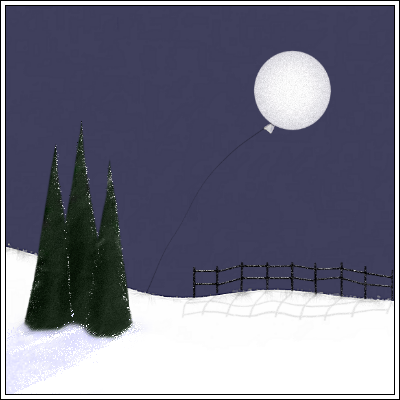
The Moon on a String


[other balloons, here and here ]

08 November 2008

VFW

Sitting with friends
at a long table cluttered
with bowls of oatmeal
and cold stacks of pancakes,
he holds his coffee mug
with both hands.

And recites the memory
of a cold ditch in Korea,
of hot chinese metal
and smoldering wool,
and the certainty
that he would burst into flames.

22 October 2008

Cuban Pickle Crisis

When I think back to the 50s and 60s, I remember that it was the era of Flying Saucers and Green Men from Mars...Xenophobia was pandemic, and paranoia ruled the day.

On October 22, 1962, President John F. Kennedy made a speech from the oval office, and frightened Americans everywhere sat in front of their televisions watching as he informed them that "large...offensive weapons of sudden mass destruction" were aimed at our country. We were doomed.

October was a major month for canning, and that particular day, we (women and young girls) were all busy putting up pickles. 12 women from 4 families on Pease Circle did what women had been doing for generations. We preserved the harvest: corn, cucumbers, tomatoes, and green beans, mostly. We did this as a small community. We were military, so we didn't have generations of continuity - only a shared heritage of preserving foods.

The threat of annihilation didn't stop us. It didn't even slow us down. Every waking hour was spent slicing, blanching, sterilizing, and filling jars. In fact, the chance that we might spend the rest of our lives underground lent an urgency to our mission. Another jar sealed was another blow to Communism.

Once the jars were cooled a bit, they were divided among the 4 households.

About 4 or 5 hours after JFK's speech, pickles stored in kitchens and porches on Pease Circle exploded. For 20 minutes, there was pandemonium. A broken window, reports of a gunshot, yelping dogs, women in housecoats pouring from every home...some armed with bats, some with rolling pins. Mrs. Janek carried a .22, and Mrs. Gorgone a BB gun. The MPs were called in.

In the end, the Russians removed their offensive weapons, and we lived to can another day.

Naturally, some doggerel:

Housecoats made the uniform
for twelve domestic soldiers true,
and curlers were the headgear worn
by several of the kitchen crew.

October, Nineteen Sixty Two
forever we will celebrate
when weapons in our pantries blew,
and invading aliens met their fate.

Green men scattered 'cross the lawns,
these marinated men from mars
glowed eerily in morning's dawn,
done knockered by exploding jars.

The juice of pickles, kosher dill,
had foiled their commie pinko plans.
It slushed their brains, and broke their will,
and gave them really stinky hands.

12 October 2007

Wearing Pants

There was time, in the olden days, when only boys were allowed to wear pants in school.

I remember it was 1958, and we’d come back to the states from Japan to a small Air Base outside of Lincoln, Nebraska.

The winters there, while not as cold as Japan’s, brought plenty of sleet. Please understand that sleet does not fall – it stabs. It is driven into bare skin by horizontal winds that invariably blow from the direction you are walking into.

For a little girl in a dress, sleet is excruciating. Mercifully, the principal of our elementary school decreed that on wintry days, for the walk to and from school, girls might wear pants under their dresses.

And I remember those coldest days when Mom would have me slip on corduroy pants. Up under my skirt and tucked into my boots, they kept me snug and warm.

For most girls, this was enough. They walked to school, gathered close, by the doors, and talked till the bell rang. And then, along with their earmuffs, mittens, and coats, they dutifully removed their pants, and draped them over the radiators to dry.

Not me. It didn’t take long before I figured out that if I tucked my dress into my pants, I could climb onto the jungle gym, race little boys on the gravel, and even play chicken on the monkey bars.

Eventually, it got so that with just a hint of cold in the air, I’d slip on a pair of pants, and as soon as I was out of Mom’s sight, I’d tuck my dress in, and run to school. I got away with it for a while, until one day a teacher recognized me, and sent me to the principal’s. He sent me home with a note, reminding my mother that girls were only allowed to wear pants when the temperatures were below freezing or if the sky was actually falling.

~ ~ ~ ~

By 1969, we were living in northern California. (If anyone ever tells you these are a liberal people, he is lying.)

I was in high school, and it was still illegal for a girl to wear pants in school. This was such utter bullshit to me, and I was about fed up. I got together with two other girls, and we decided to say something about it. We organized a protest. We convinced 100 or so girls to bring a pair of slacks to school. And during the break between 2nd and 3rd period, we all met in the girl’s room just east of C-wing, and changed.

Quietly, we lined up outside the wing, in pairs, and waited till ten minutes into the classes we were all now missing. We opened up the double-doors, and marched in singing:

♪ All we are say-ying is, ‘give pants a chance.’ ♪

We marched down the hall, and out through the double-doors at the other end, did a once-around the administration building, and then stopped once we had completely circled. We started clapping while we sang.

Several of the office ladies looked out to see what the commotion was. I remember two who smiled, but most of them were shocked, and the principal - he was outraged. He called the Wheatland Police(man), who showed up within minutes. Together, they threatened us all with arrest if we - didn’t - shut - up.

The cop took all our names, and one by one, we were lead into the vice-principal’s, principal’s, and nurse’s offices for questioning. “Who instigated this?” “Who convinced you to break the law?”

It didn’t take long for someone to spill the beans, and give up the names of the 3 bad seeds who’d evilly influenced these otherwise innocent girls.

All participants were sent home for the day. This was no small feat, by the way. The high school was a good twenty-minute drive from Beale Air Force Base, and while busses were provided to bring us there, the school wasn’t about to waste good money to taxi a bunch of juvenile delinquents home. The parking lot only had enough spaces for employees, so our parents were forced to park their cars all along the narrow lane that led to our school from the highway. 100+ students meant 100+ cars and 100+ very angry parents.

The other protestors were allowed back to school the following day, but my two cohorts and I were suspended for 3 days, and the entire disgraceful incident was documented on our transcripts – our permanent records.

The slacks I wore that day were of thin-waled corduroy. A fine black and white hound’s-tooth. I kept them for years as a reminder.

24 May 2007

Missoula Peace Sign


Once upon a time, there was a peaceful village in a beautiful valley surrounded by green grassy hills, and the people who lived in the valley were happy.

Then one day, the evil bastards at US-West built a giant ugly billboard, the size of a 3 story building just cuz they could. "It's private land and we have rights. So go on about your daily business while we bounce microwaves at ya."

So, when the evil bastards weren't looking, the people from the peaceful village gathered a hundred gallons of paint, some brushes, some ladders, and some rope. And they trekked up the hill. And with their ladders, they climbed the evil, ugly microwave reflector, carrying their paint and brushes with them.


It took many, many hours, but they finished finally, and with their paint they made the reflector beautiful, and on it was a message for all the people of the valley.


17December2011: An image of the T-shirt I refer to in the comment section is now found here.

24 January 2007

...feelin' nostalgic again.

I was walking down SW Higgins, and noticed that the Senior Center is having Pinochle Night. Damn, but I miss Pinochle. I’m still too young to join the seniors, and folks my age are busy cruising the chatrooms or watching CSI.

I miss the sound of people chatting over the kitchen table. I miss the power going out at least once a week, and mom heating coffee over a candle flame.

Growing up military, everybody's parents played Pinochle. It was the poor man’s Bridge. They played partnership when men were home, and
cutthroat when they were gone. And if the power went out, that didn’t matter. They’d play Pinochle by candlelight.

Pinochle for our parents always included refreshments. The table was always crowded with victory mugs, open beer cans, cigarette packs, Zippos, and ashtrays. Back in the day, everybody smoked. Cigarettes were practically free to GIs. I can still see them all talking with cigarettes in their mouths, squinting against the smoke burning their eyes!

My dad used to smoke 4 packs of Pall Malls a day, and my mother, 3. I can’t remember a single adult who didn’t smoke at least 2 ½.

Remember when ashtrays were a part of the décor? Ceramic, ironstone, and glass…and some even of crystal. There was at least one in every room. I remember some butt ugly ones carved and polished from granite and marble. Some even had matching lighters. I think they came from Italy. Very, very large. Of course, no one actually soiled them with cigarette tar and ashes. They were just for saying, I was stationed at or near Italy.

And you could pretty much tell which family’d been stationed where. People who’d been to Germany always had an over-carved, Black Forest cuckoo clock. People who’d been to Turkey had the requisite, decoratively engraved, matching ensemble of brass bells, brass decanters, brass ashtrays, and brass end tables. And people who’d been to Japan had geisha dolls and silk lampshades – pagoda shaped, of course. (These are the days before Japan started dominating the electronics market.)

And every house on base had a hideous, gigantic wooden fork and spoon hanging on its dining room wall. I don’t know where they came from. We had to be the only Air Force family in 50 states that didn’t have the set. Although we did have an obscenely large wooden bowl my mom served salad in, with its own too-large wooden fork and spoon. And yes, I think they matched the set hanging on those other walls!

25 October 2005

Buzzard Bait

The year Tommy turned 9, he and Pat decided that they needed a pet buzzard. The problem was, they couldn’t seem to get close enough to any buzzards to grab them.

But Tommy had a idea. Buzzards eat dead things, so all we need to do is get one to think we’re dead, and he’ll walk right up to us. Then we’ll grab him!

Pat wasn't so sure. He’ll know we’re just faking cuz we don’t look dead.

But Tommy said, Not if we look like we just this minute died from bleeding to death.

So, the next day, before leaving for the hills, Tommy snuck into his mother’s pantry, and got himself a bottle of ketchup.

They found the perfect clearing, and only after they staged a convincing battle in which they would both die, Tommy and Pat put down their wooden rifles, and opened the new bottle of ketchup. They took turns pouring its contents on each other, and then crawled almost 20 feet in the tall dry grass, moaning, Oh I’m dying. I’m dying.


Naturally, they had to make certain that the buzzard was convinced. So for good measure, the boys got up and did their best I’ve-just-been-shot-by-the-Enemy collapse, falling back to the ground.

And then they waited.

On their backs, they waited. And they planned about what to do when the buzzard walked up to eat them. I’ll get up and grab him by his legs. No. I’ll jump on top of him. Should we tie him up with my belt? Hey, shut up. He’s probably looking at us, right now!

And for a long while, watching the blue, cloudless, buzzardless sky, neither said a word.